In recent times, I have been putting some thought into designing a load generator that simulates queued-based manufacturing processes - think car assembly lines or SMT lines. A key detail about these types of setups is that they’re susceptible to traffic jams: if a station at the end of the line breaks, the entire line backs up until the problem is fixed.
The intrinsically linear nature of these manufacturing setups creates dependencies between the materials in the line: panel #345436 can only enter the next machine if panel #345437 has finished processing, which in turn needs panel #345438 to clear the conveyor belt… you get the point.1
Simulating these lines with a stateful load generator approach will not work because it handles each panel independently - one would need to layer an absolutely obscene amount of synchronization code2 on top to make the panels behave in a way that somewhat resembles a real-world SMT line. It’s just not feasible.
We need a new approach.
The case for a machine-centered load generator Link to heading
Instead of having a panel-centric load generator, we should have a load generator that is focused on the machines that handle the panels. Each resource would then be handled by its own dedicated thread which would be tasked with simulating the machine’s behaviour: receiving new panels, “processing” them, and sending them to the next machine.3 With this approach, each machine can independently enforce its own constraints by refusing to perform any given operation if its internal conditions are not met.
This is a good idea in principle… as long as we figure out how we are going to transfer materials. In other words, how should a handover of a panel from resource A to resource B occur?
The handover problem statement Link to heading
Given two machines A and B running on independent threads, if the following conditions are met:
- Machine A wishes to send a material by calling
send(). - Machine B wishes to receive a material by calling
receive().
The panel should be transferred from machine A to Machine B, and both send() and receive() should return true when the transfer is completed.
The functions send() and receive() should also be atomic, thread-safe and able to support timeouts.
Some reflections Link to heading
Our handover challenge is fundamentally a synchronization problem involving two independent threads - we should take inspiration from the field of concurrent programming and define a wishlist of properties that our conceptual data structure will need to have:
- Is a zero-capacity queue (i.e. the sender blocks until the receiver is ready to receive).
- Supports multiple producers and multiple consumers (i.e. thread-safe).
- Supports timeouts.
- Is written in async C# (because, well… I need it to be written in async C#).
The solution: an order book protected by a mutex Link to heading
What does it mean when Machine A calls send()? Does it mean that there’s a 100% guarantee that the panel will be sent? No. It means that Machine A is interested in sending the panel, and if there’s matching interest from the other side, a trade will happen… hold on, is this a stock market? Our send() calls are the equivalent of sell orders and our receive() calls represent buy orders!
Whenever there’s an available receive() order and an available send() order, they are matched, removed from the “order book” and the panel is transferred.
The remainder of this blog post will focus on implementing this data structure, which I will name ZeroQueue:
The core data structures Link to heading
Our ZeroQueue class will have three properties: the Send Orders, the Receive Orders, and a mutex that guards the access to the 2 previously mentioned properties:
class ZeroQueue<T>
{
    /// <summary>
    /// Pending send orders
    /// </summary>
    private List<SendOrder<T>> SendOrders = new();

    /// <summary>
    /// Pending receive orders
    /// </summary>
    private List<ReceiveOrder> ReceiveOrders = new();

    /// <summary>
    /// Mutex that protects accesses to the SendOrders and ReceiveOrders fields.
    /// </summary>
    private readonly SemaphoreSlim QueueLock = new SemaphoreSlim(1, 1);

    // ...
}
The SendOrder and ReceiveOrder structs have the following fields:
/// <summary>
/// Represents a Task's intention of sending a Panel
/// </summary>
struct SendOrder<T>
{
    /// <summary>
    /// Unique Id for this order
    /// </summary>
    required public Guid Id;

    /// <summary>
    /// If set, it means that this Send Order is reserved
    /// for the Receiver Task whose Id equals ReservedReceiverId.
    /// </summary>
    required public Guid? ReservedReceiverId;

    /// <summary>
    /// The panel to be sent to the next machine.
    /// </summary>
    required public T Entity;

    /// <summary>
    /// Signal mechanism to wake up the Task behind this order once a match is found
    /// </summary>
    required public TaskCompletionSource<bool> Notification;
}
/// <summary>
/// Represents a Task's intention of receiving a Panel
/// </summary>
struct ReceiveOrder
{
    /// <summary>
    /// Unique Id for this order
    /// </summary>
    required public Guid Id;

    /// <summary>
    /// Signal mechanism to wake up the Task behind this order once a match is found
    /// </summary>
    required public TaskCompletionSource<bool> Notification;
}
These two structs are pretty self-explanatory, with perhaps the exception of the SendOrder’s ReservedReceiverId field: the reason for that field’s existence is to prevent a race condition.
Utility methods Link to heading
To keep the main algorithms as lean as possible, I wrote these small utility functions that help us manipulate SendOrders and ReceiveOrders:
    /// <summary>
    /// Remove order from <see cref="ReceiveOrders"/> and cancel the associated Task, if it exists.
    /// This function must only be called if <see cref="QueueLock"/> is acquired.
    /// </summary>
    private void RemoveReceiveOrder(Guid guid)
    {
        for (int i = 0; i < ReceiveOrders.Count; i++)
        {
            if (ReceiveOrders[i].Id == guid)
            {
                // Cancel the notification task. Doing this is important to avoid having "zombie" tasks filling our memory.
                ReceiveOrders[i].Notification.SetCanceled(); // No one should be awaiting this Task, so calling SetCancelled() should pose no problem.
                ReceiveOrders.RemoveAt(i);
                return;
            }
        }
        // If no match found, throw exception
        throw new Exception($"No Receive Order with id {guid} was found.");
    }
    /// <summary>
    /// Remove order from <see cref="SendOrders"/> and cancel the associated Task, if it exists.
    /// This function must only be called if <see cref="QueueLock"/> is acquired.
    /// </summary>
    private void RemoveSendOrder(Guid guid)
    {
        for (int i = 0; i < SendOrders.Count; i++)
        {
            if (SendOrders[i].Id == guid)
            {
                // Cancel the notification task. Doing this is important to avoid having "zombie" tasks filling our memory.
                SendOrders[i].Notification.SetCanceled(); // No one should be awaiting this Task, so calling SetCancelled() should pose no problem.
                SendOrders.RemoveAt(i);
                return;
            }
        }
        // If no match found, throw exception
        throw new Exception($"No Send Order with id {guid} was found.");
    }
Please note that in the two tasks above, we’re cancelling the Notification task completion source to prevent leaking tasks to memory. It is entirely possible that the GC will perform this cleanup for us, but I’m not taking any chances here.
    /// <summary>
    /// Returns the index of the first send order that matches the reservedReceiverId.
    /// Returns null if no match is found.
    /// </summary>
    private int? FindSendOrderByReservedId(Guid? reservedReceiverId)
    {
        for (int i = 0; i < SendOrders.Count; i++)
        {
            if (SendOrders[i].ReservedReceiverId == reservedReceiverId)
            {
                return i;
            }
        }
        // Fallback
        return null;
    }
The TrySendAsync() method Link to heading
The logic behind this method goes as follows:
- Acquire the
QueueLockand do the following:- If there’s a
ReceiveOrderavailable, trigger its notification mechanism, capture itsIdand remove it from theReceiveOrderslist. - Create our
SendOrder.- If we found a
ReceiveOrderin the previous step, set ourReservedReceiverIdto theIdof thatReceiveOrder.
- If we found a
- If there’s a
    /// <summary>
    /// Attempts to send the panel to the next machine.
    /// </summary>
    /// <returns>true if the handover of the panel is successful, false if a timeout or cancellation is triggered.</returns>
    public async Task<bool> TrySendAsync(T panel, TimeSpan timeout, CancellationToken cancellationToken)
    {
        Guid orderId = Guid.NewGuid();
        Guid? receiverId = null;
        TaskCompletionSource<bool> notification = new(TaskCreationOptions.RunContinuationsAsynchronously);

        await QueueLock.WaitAsync();
        // If there's a receive order waiting for a new send order, wake it up and remove that receive order!
        if (ReceiveOrders.Count > 0)
        {
            receiverId = ReceiveOrders[0].Id;
            ReceiveOrders[0].Notification.SetResult(true);
            ReceiveOrders.RemoveAt(0);
        }

        // Add a new send order to the list
        SendOrders.Add(new SendOrder<T>
        {
            Id = orderId,
            ReservedReceiverId = receiverId,
            Entity = panel,
            Notification = notification,
        });
        QueueLock.Release();
- Wait until either the notification of our
SendOrderis triggered, or the timeout is triggered.- If there was a
ReceiveOrderavailable in step 1, we will disregard the timeout - the reason for this is that we know that the receiver has been signaled and expects ourSendOrderto be present. We can only guarantee that ourSendOrderwill be there if we ensure that a timeout will not be triggered before the receiver has fetched ourSendOrder. We do this by setting the timeout toTimeout.InfiniteTimeSpan.
- If there was a
        // We're creating this combinedCts so that we can terminate the sleepTask
        CancellationTokenSource cancelSleep = new();
        using var combinedCts = CancellationTokenSource.CreateLinkedTokenSource(cancellationToken, cancelSleep.Token);

        Task<bool> notificationTask = notification.Task;

        // If receiverId != null, we know that we've woken up a receiver task that will be looking for our send order.
        //
        // In this scenario, we need to avoid a potential situation where the sleepTask triggers before the notificationTask,
        // which would lead to the unintended removal of our SendOrder... which the receiver task expects to exist.
        //
        // We avoid this problem by setting the timeout to infinite.
        Task sleepTask = Task.Delay(receiverId == null ? timeout : Timeout.InfiniteTimeSpan, combinedCts.Token);

        // Wait until something happens to one of these two tasks
        await Task.WhenAny(notificationTask, sleepTask);

        // Cancel the sleep task, if it's not already finished
        // We have to do this to avoid having a memory leak (this sleepTask is not garbage-collected when we exit the function).
        cancelSleep.Cancel();
- Check the status of our notification task
- If our notification triggered, return true - the panel was transferred successfully.
- Otherwise, acquire the
QueueLockand do the following:- Check again if our notification triggered (we perform this check twice to prevent a race condition).
- If it wasn’t triggered, that means that the timeout task was triggered instead. Therefore, we should remove our
SendOrderand return false.
        if (notificationTask.IsCompletedSuccessfully)
        {
            // A receiver task triggered our notification task, removed our send order, and returned the panel.
            // The panel has been handed over successfully, we're done here!
            return true;
        }
        else // The sleep task completed
        {
            await QueueLock.WaitAsync(); // By holding the lock we ensure that we have exclusive access to our own notificationTask.

            if (notificationTask.IsCompletedSuccessfully) // The notification task was triggered immediately after the sleep task.
            {
                // A receiver task triggered our notification task, removed our send order, and returned the panel.
                // The panel has been handed over successfully, we're done here!
                QueueLock.Release();
                return true;
            }
            else
            {
                // The notification task was not triggered, which means that our send order still needs to be cleaned up.
                RemoveSendOrder(orderId);
                QueueLock.Release();
                cancellationToken.ThrowIfCancellationRequested(); // Propagate the cancellation if necessary.
                return false;
            }
        }
    }
The TryReceiveAsync() method Link to heading
This method will naturally be the counterpart to the TrySendAsync() method. This is how it works:
- Acquire the
QueueLockand do the following:- If there’s a
SendOrderwithReservedReceiverIdset tonullavailable, trigger its notification mechanism, remove it from theSendOrderslist and return the panel from theSendOrder. We’re done here! - Otherwise, create our
ReceiveOrder.
- If there’s a
    /// <summary>
    /// Attempts to receive a panel from the previous machine.
    /// </summary>
    /// <returns>true & the panel if the handover is successful, false if a timeout or cancellation is triggered.</returns>
    public async Task<(bool Success, T? Panel)> TryReceiveAsync(TimeSpan timeout, CancellationToken cancellationToken)
    {
        Guid orderId = Guid.NewGuid();
        TaskCompletionSource<bool> notification = new(TaskCreationOptions.RunContinuationsAsynchronously);

        await QueueLock.WaitAsync();
        int? matchIndex = FindSendOrderByReservedId(null); // Looking for a SendOrder with a null ReservedReceiverId
        if (matchIndex != null) // There's an unmatched SendOrder waiting for us
        {
            // If there's a send order already waiting there, we can immediately return that send order's panel.
            var res = (true, SendOrders[(int)matchIndex].Entity);

            SendOrders[(int)matchIndex].Notification.SetResult(true); // Notify the sender.
            SendOrders.RemoveAt((int)matchIndex); // Remove the send order.

            QueueLock.Release();
            return res;
        }
        else // There's no send order available for us to take, so let's create a receive order and wait for an update
        {
            // Add a new receive order to the list
            ReceiveOrders.Add(new ReceiveOrder
            {
                Id = orderId,
                Notification = notification
            });
            QueueLock.Release();
        }
- Wait until either the notification task of our
ReceiveOrderis triggered, or the timeout is triggered.
        // We're creating this combinedCts so that we can terminate the sleepTask
        CancellationTokenSource cancelSleep = new();
        using var combinedCts = CancellationTokenSource.CreateLinkedTokenSource(cancellationToken, cancelSleep.Token);

        Task<bool> notificationTask = notification.Task;
        Task sleepTask = Task.Delay(timeout, combinedCts.Token);

        // Wait until something happens to one of these two tasks
        await Task.WhenAny(notificationTask, sleepTask);

        // Cancel the sleep task, if it's not already finished
        // We have to do this to avoid having a memory leak (this sleepTask is not garbage-collected when we exit the function).
        cancelSleep.Cancel();
- Acquire the
QueueLockand do the following:- If our notification task triggered, that means there’s a
SendOrderreserved for us - we need to find it, trigger its notification mechanism, remove it from theSendOrderslist and return the panel from theSendOrder! - Otherwise, that means that the timeout task was triggered instead. Therefore, we should remove our
ReceiveOrderand return false.
- If our notification task triggered, that means there’s a
        // By holding the lock we ensure that we have exclusive access to our own notificationTask.
        await QueueLock.WaitAsync();

        if (notificationTask.IsCompletedSuccessfully)
        {
            // We're guaranteed to have a SendOrder reserved for us
            int sendOrderIndex = (int)FindSendOrderByReservedId(orderId)!;

            var res = (true, SendOrders[sendOrderIndex].Entity);

            SendOrders[sendOrderIndex].Notification.SetResult(true); // Notify the sender.
            SendOrders.RemoveAt(sendOrderIndex); // Remove the send order.
            QueueLock.Release();

            return res;
        }
        else // The sleep task completed
        {
            RemoveReceiveOrder(orderId);
            QueueLock.Release();
            cancellationToken.ThrowIfCancellationRequested(); // Propagate the cancellation if necessary.
            return (false, default);
        }
    }
Visualizing TrySendAsync() and TryReceiveAsync() Link to heading
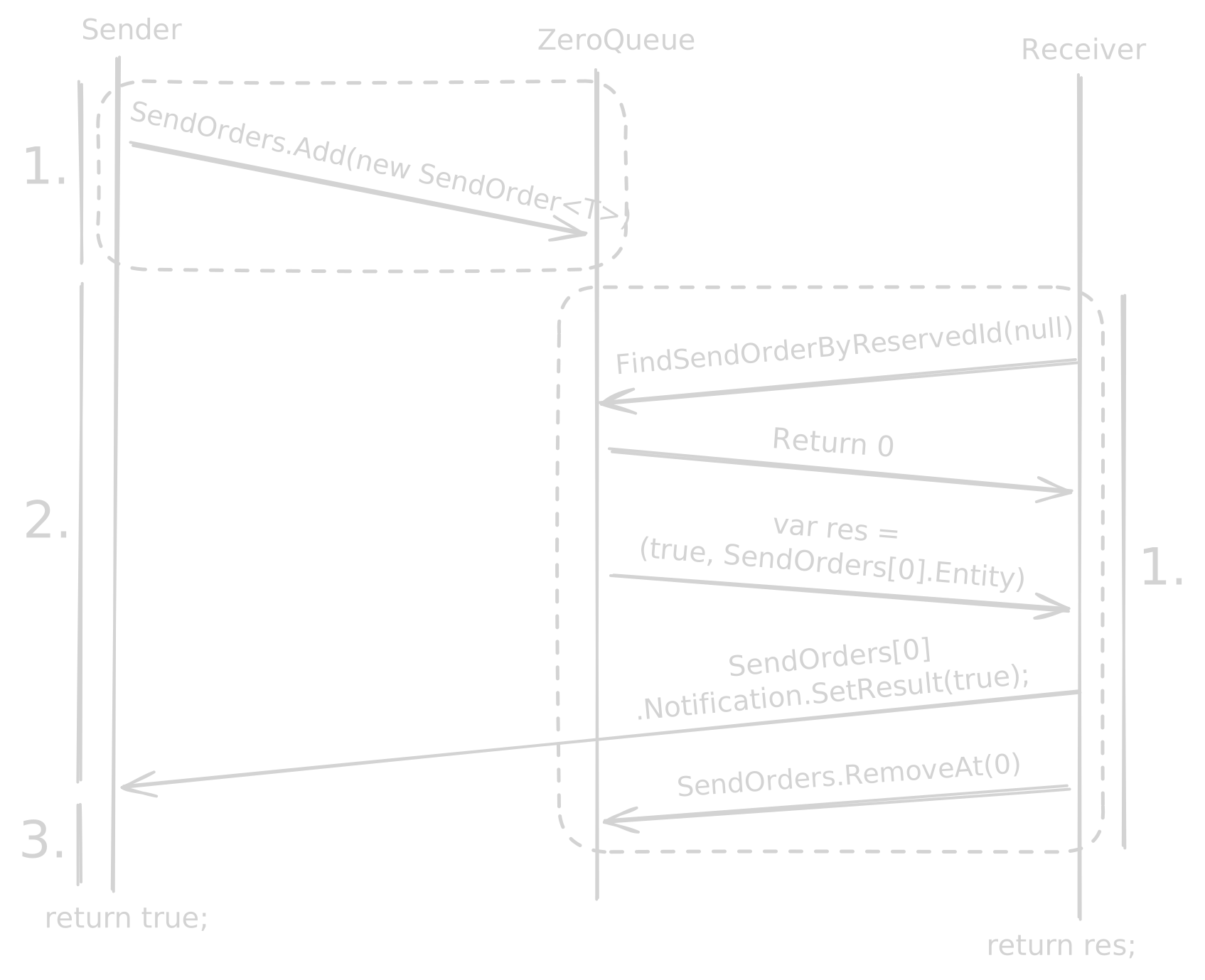
Reading the code is one thing, but what would really help us understand these methods is some visualizations of them working. I’ve found sequence diagrams to be pretty useful for this purpose:
TrySendAsync() first, followed by TryReceiveAsync() Link to heading
TryReceiveAsync() first, followed by TrySendAsync() Link to heading
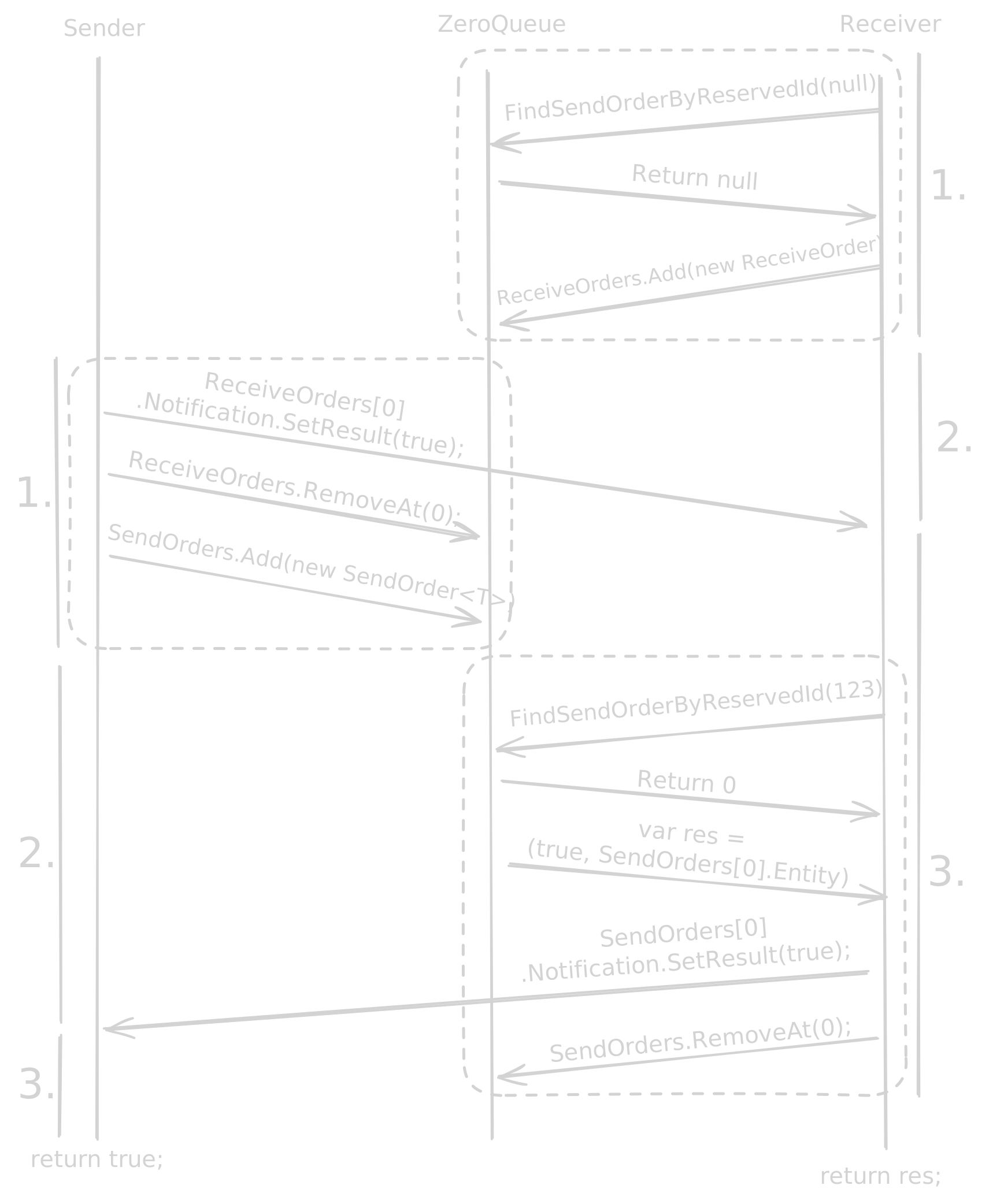
The boxes with dashed lines indicate who holds the QueueLock. The 1. 2. 3. annotations refer to the algorithm explanations from the previous chapter.
Convincing yourself that the code actually works Link to heading
Writing multithreaded code is not that hard - what’s difficult is making sure that the code works under all circumstances! This requires you to think of every possible deadlock scenario, every possible race condition and ensuring that they are all accounted for.4
With this in mind, let’s consider some potentially problematic scenarios:
Notification & timeout race conditions Link to heading
In both TrySendAsync and TryReceiveAsync, we wait for one of these two tasks to complete:
// Wait until something happens to one of these two tasks
await Task.WhenAny(notificationTask, sleepTask);
What happens if they both complete at the same time? Or one immediately after the other? We handle this race condition by acquiring the QueueLock: doing this prevents the state of notificationTask from changing (because you need to hold the QueueLock to trigger a change in notificationTask).
Now that we know that notificationTask will not change, we can check its state without fear of it changing under our feet.
Race condition between two receive tasks Link to heading
There’s another more complex scenario that also merits attention. Imagine this sequence of events with receivers R1, R2, and sender S1:
- R1 calls
TryReceiveAsync(). As there is no matchingSendOrder, R1 creates aReceiveOrderand waits for a notification. - S1 calls
TrySendAsync(). R1’s notification is triggered, and S1 creates aSendOrderfor R1 to consume. - R2 calls
TryReceiveAsync(), beats R1 to theQueueLock, sees that S1’sSendOrderis available and takes it! - S1 receives a notification, meaning that its
SendOrderhas been consumed. Job done. - R1 finally acquires the lock expecting a
SendOrderto exist, but it discovers thatSendOrdersis completely empty!
The problem here is that even though S1 creates a SendOrder with the expectation that the receiver that triggered its notification will consume it, there’s nothing that prevents a random receiver task from “sneaking in” and stealing this SendOrder that was meant for someone else.
The fix for this stealing issue is a dedicated ReservedReceiverId field in the SendOrder struct that reserves this SendOrder for a specific ReceiveOrder:
struct SendOrder<T>
{
    // ...

    /// <summary>
    /// If set, it means that this Send Order is reserved for the Receiver Task whose Id equals ReservedReceiverId.
    /// </summary>
    required public Guid? ReservedReceiverId;

    // ...
This is also why we don’t simply fetch the first SendOrder in the SendOrders list in the TryReceiveAsync() method: we instead look for a SendOrder with a null ReservedReceiverId:
public async Task<(bool Success, T? Panel)> TryReceiveAsync(TimeSpan timeout, CancellationToken cancellationToken)
{
    Guid orderId = Guid.NewGuid();
    TaskCompletionSource<bool> notification = new(TaskCreationOptions.RunContinuationsAsynchronously);

    await QueueLock.WaitAsync();
    int? matchIndex = FindSendOrderByReservedId(null); // <--- Looking for a SendOrder with a null ReservedReceiverId
Final notes Link to heading
You can find the code related to this blog post here.
-
This concept is called “Back Pressure” in software engineering. ↩︎
-
Think mutexes, semaphores, etc. ↩︎
-
You can think of this as a manufacturing simulation-oriented Actor Model. ↩︎
-
There are formal methods for validating concurrent algorithms, but in this blog post we will be taking a much more informal approach to making sure that our algorithm works. ↩︎